
Procrastination and Trauma: there's a surprising connection
Did you know procrastination and trauma are connected in surprising ways? Drop in perfectionism and it makes for a crazy triangle. The good news is, if you're a perfectionist who struggles with getting things done, you're not alone, and it's not about laziness. The link between childhood trauma, shame, perfectionism, and procrastination is well-documented, and it isn't a life sentence. Let's talk about it.
In fact, let's start with a personal illustration: today is my writing day. My desk is cleaned off, and I even have fresh flowers in a vase nearby. There's a clutch of pens standing proud in their little coffee-cup holders, waiting patiently for my moments of inspiration. Even my laptop is open and ready to roll. (You might have noticed that it is not actually open to the writing program, but is still parked at the springtime screensaver.)
But, in theory, I'm ready to write. Except, all of a sudden, I had to organize the pantry. And Google a bunch of not-writing-related subjects. Oh, hey! I know, let's throw in an extra load of laundry (it's hard to complain about doing that, but it isn't writing, and I'm supposed to be writing!). Then, I decided it would be kind to play with the cat rather than ignore him as I usually do when I'm writing. Oh, wait. I wasn't writing. I was supposed to be writing.
It felt like I was getting a lot of things done. But the only person I was fooling was myself. Even the cat knew I was procrastinating. I mean, look at his expression. "Really, Mom?" (It's a cat thing, I guess.)
Sometimes I think procrastination might be my strongest skill set (I am really good at it). I've learned that in blogger-world anything and everything is grist for the mill, so my tendency to distract myself for no good reason has now become the topic of a blog post on procrastination. Well, that's one way to get motivated, right?
Seriously, though. Does this sound familiar? I'll bet it does, because it's a very common problem. Research shows that around 20% of adults are chronic procrastinators, meaning it's a habit they default to without thinking about it (Harriott & Ferrari, 1996, Psychological Reports). And for women with a history of trauma or abuse, that number could be much higher, because for us, procrastination isn't a time management problem. It's a trauma response.
Procrastination and Trauma: how abuse creates the perfectionism cycle
You probably know that perfectionism is a big contributor to procrastination. Research shows a link between perfectionism and histories of trauma and abuse.
Abuse and trauma lead to shame, and that is the magic pixie dust in this icky triad. See, it's not the trauma that creates the perfectionist, not in the literal sense; it's the shame. It's my effort to try and fix the problem (and the belief that what I need to fix is me). So I keep trying, continually reducing my tolerance for imperfection in the search to be "better," and turning into a perfectionist.
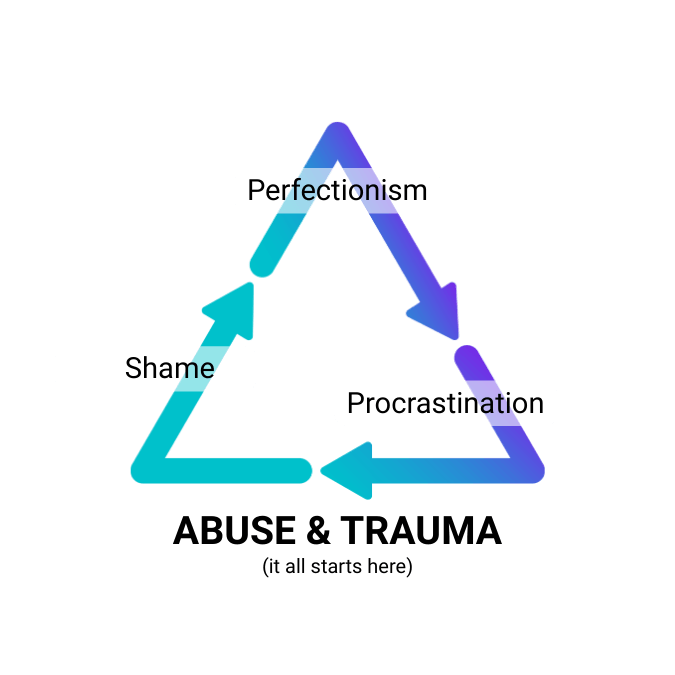
It's shame that leads us to try to apply a solution to the outside that fixes and cleans up the inside. To always be better. We can become performance junkies, always trying to outdo the competition (me, myself, and I are the competition, btw).
However, underneath all that "doing" is a hope that I can somehow become less unworthy if I could only get it right. Whatever the "it" is in the moment. And whatever getting it right might look like. The rules keep changing, and the goalpost keeps moving.
Here's what's fascinating: researchers at two separate universities used brain imaging on over 1,100 people and found that childhood trauma is a significant predictor of procrastination — and that the link runs specifically through anxiety and reduced self-control. (NeuroImage, 2025)
In plain English? The traumatized brain isn't being lazy. It's afraid! The fear centers light up when facing a task, the same way they light up when facing a threat. Same brain. Same alarm system. Different trigger.
Shame Twists Our Thinking: why I can't rest in my accomplishments
Therefore, even if I meet my external goal, say, writing 1,000 words today, my shame filter will twist my thoughts so that, rather than basking in a lovely sense of fulfillment and joy, I'll experience fleeting satisfaction coupled with a nagging sense of disquiet.
My shame filter will pressure me to do better next time. Write more than 1,000 words this time. Or 1,000 words plus three photos. Maybe I should take a class and learn more about writing. Yeah, that could help do this better. (Not that I'm anti-taking-classes; I love taking classes.)
Do you see what I mean about the never-ending search for "better?" If we have abuse histories, that search may originate from a deeply-seated core of shame.
The Shame Filter: mental sunglasses that distort reality
Before we go on, I mentioned a shame filter. Let's clarify that. Simply put, when someone is abused, they develop shame. Shame says that it's not what I've done that's bad, it's me that's bad. I. Am. Bad.
This becomes a habitual way of looking at oneself and is also the lens through which we see the world: all of it. It's like looking at everything, including our reflection in the mirror, with sunglasses on. The sunglasses create a filter through which we see the world. Shame creates a filter like that.
So, in the illustration above, where I talk about how my shame filter twists my thoughts, the shame filter acts as mental sunglasses, shifting my view of the truth. In truth, I did well, but my "sunglasses" change my experience. That's the shame filter at work. It never lets us be content; like a race that has no goal line, it's always pushing us.
A Never-ending Search for "Better:" why perfectionism backfires
This can be a slippery slope. Of course, there should be nothing wrong with wanting "better," or self-improvement, right? Unfortunately, if I have a history of shame, performing as a means of elevating my self-worth is going to be a double-edged sword. The fuel that drives shame is negative.
Without even knowing it's a problem, I can get stuck in wanting so badly to be worthwhile that I can't actually finish (or begin) a project until it's perfect. Moreover, I can begin to shame myself for not doing better. Because it truly isn't about being better in any way that can be achieved. It's about chasing a ghostly internal vision that vanishes when you think you've grasped it.
This is a thinking loop and a snare. My unconscious will think, "anything less than perfect will not make me look better, it will make me look worse". And I become paralyzed. Who needs THAT!?

"94% of people say procrastination negatively affects their happiness — yet most chalk it up to laziness.
For trauma survivors, it was never about laziness.
It was always about protection.
(Source: Solving Procrastination)
Psychologists call this procrastination as a trauma response. It's not a character flaw (like laziness) or a discipline problem (like disobedience) — it's the nervous system doing exactly what it learned to do in an environment where "not good enough" had unpleasant consequences.
The good news? What it learned can be unlearned and replaced with new, more intentional ways of thinking and living. That's not just me being encouraging. That's neuroscience. That's neuroplasticity, to be more specific, and because of it, we have hope that we can change our procrastinating perfectionism (Journal of Counseling Psychology, via Compassionate Hearts United).
Pay attention, Friend: We. Can. Change. This.
Breaking Free from the Procrastination Loop: finding hope, healing and transformation
Here's what I want you to take away from all of this. Procrastination and trauma are connected — and that connection runs deeper than the average productivity expert realizes. Your brain learned avoidance behaviors, such as procrastination and perfectionism, as a way to protect you. It did its job.
But you are not the same person you were when those protective thought-patterns formed. You have worked hard for healing and wholeness. You know things now that your younger self couldn't have imagined.
And that means the procrastination loop can be broken.
It's like this: your planners, color-coded calendars, and habit-stacking will help you know what's next, but they won't necessarily get you moving to do them. For that, you need to break the procrastination loop, starting with understanding what's actually driving the avoidance.
For some of us, that means spending some time with a mental health professional. For others, a 12-step program can be helpful. You might find yourself succeeding simply by asking a trusted friend to come alongside as an accountability and prayer partner. In all cases, though, begin by surrendering your struggle to the Lord and taking your thoughts captive (see Romans 12:2) to filter your natural thoughts and align yourself with God's truth.
Then, one baby step at a time, you'll walk yourself forward. That's not a productivity hack. That's transformation. And transformation, my friend, is God's specialty.
"Therefore, if anyone is in Christ, the new creation has come: The old has gone, the new is here!"— 2 Corinthians 5:17 (NIV)
You are a new creation. Your past wired you a certain way — but it does not get the final word. God does.
Let's do this. 💛
“Therefore, if anyone is in Christ,
The new creation has come:
The old has gone, the new is here!"
~2 Corinthians 5:17 NIV ~
Let's Stay Connected!
I send out encouragement, practical tools, and Biblical insights for women navigating life after trauma.
When you join, you'll get instant access to my Acute Stress Response infographic — a quick visual guide to understanding what's happening in your body when you're triggered.