
Understanding Trauma: How Your Past Influences Today
Understanding trauma helps you see how your past still influences, or shapes, today — and how God’s truth can lead you into healing, clarity, and hope
Why It Matters
God designed your brain to keep you safe. It scans for danger, reacts without asking permission, and builds habits that protect you. But what if those habits are also keeping you from taking your next step? Let's consider six key keys to clarity — and how understanding trauma can equip you to leave those old thinking patterns and reactions where they belong: in the past.
Emotions are real, but they aren't evidence
Your feelings are real, but they’re not always true. Don't give them more authority than they deserve.
What if doubts don't lead to detours?
Self-doubt doesn't need to throw you off-course. You can take your next step in spite of feeling like an imposter.
Freezing is a signal, not a solution
When life signaled, "fear," you froze. Invisibility kept you safe back then. Now your brain needs a better solution.
God's voice brings peace, not panic
His words never rush or accuse. They calm your chaos and lead you to safety. Like sheep know their shepherd anywhere, you can know God's voice, too.
You're not disqualified, you're prequalified
Your painful story may be the very thing God will use to help someone else. Your path through suffering might offer someone else true hope.
When fear meets faith: let's do it anyway
You may not feel ready. But obedience starts with trust, even in the presence of fear. His plans are certain, and with His help, you can do that thing.
How Trauma Affects Your Brain (And Why That's Good News)
Here's something that might surprise you: your brain isn't broken. I know, there's all those times it feels like it's working against you: when you freeze up in a meeting, when you can't shake that anxious feeling, when you pull away from people who care about you . . . but at those times, believe it or not, your brain is actually doing exactly what God designed it to do.
The problem isn't the design. It's that your brain is still running an old program that doesn't fit your current reality.
It's kind of like having an app that didn't get the update. Let me explain.
Your Brain's Job: To Keep You Alive
God built an incredible defense system into your brain. At the center of it is a small, almond-shaped part called the amygdala. Think of it as your brain's smoke detector - it's constantly scanning for danger, and when it picks up a threat, it sounds the alarm.
This happens faster than conscious thought. Your amygdala can trigger a full-body response before you even realize something's happening. That's intentional. When there's real danger - a car swerving into your lane, a physical threat - you need to react now, not after you've had time to think it through.
So your brain does what it needs to do. It perceives a threat through a combination of senses and memories. Then, in nanoseconds, it floods your system with stress hormones, your heart rate spikes, and your body prepares to fight, run, or freeze. This is survival mode, and it's kept human beings alive for thousands of years.
But it can sometimes get a bit more complicated.
When the Alarm Won't Turn Off
The challenge with trauma is that the alarm system can get stuck in the 'on' position.
Maybe you grew up in a home where you never knew what mood you'd walk into. Maybe you experienced betrayal from someone who was supposed to protect you. Maybe the danger was found in military combat, workplace harassment, or a relationship where you were never safe to be yourself.
Whatever the source, your brain learned that the world isn't safe. People aren't safe. Sooner or later, that other shoe would drop. And the only way to survive is to stay on high alert.
So that's what it did. And it worked. You made it through that difficult season. Or maybe you're still in that difficult season -- the principles still apply.
How Your Brain Learns Trauma Patterns
The thing is, your brain trains itself through your experiences and your interpretations of those experiences. As a child, or as a person in a powerless position, those abusive moments take on great significance. Pretty soon, your brain sees threats everywhere, because its job is to keep you alive.
Your amygdala doesn't always distinguish between "back then" and "right now." It doesn't have a calendar (the calendar is stored in your prefrontal cortex, which is slower to react than the amygdala). So it doesn't always identify correctly what is actual danger or is a situation that just reminds you of danger.
At the moment that your brain thinks, "this" feels like "that," the alarm goes off. Even if the two things are not the same at all.

This is why your chest might feel tight when someone uses a certain tone of voice, even if they aren't talking to you. Why you might shut down in a conversation that feels too intense, even though the person across from you is safe. Or why a situation that looks nothing like your past can still trigger that old familiar feeling of "I need to get out of here."
Your brain is picking up on a pattern - a tone, a facial expression, a power dynamic - and it's saying, "I've seen this before. Last time this happened, we got hurt. We're not doing that again."
It's got a strategy. It's trying to protect you. The problem is, it's protecting you from something that isn't actually happening anymore.
Your Brain Doesn't Automatically Update Its App
Here's the tricky part: your brain doesn't automatically update its app. Your prefrontal cortex is the part of your brain that knows, logically, that we're here, not there, and it's now, not then. You know this guy is not your abusive dad, or this woman is not like your crazy ex-wife. But logic alone will not update the app, and that's why you feel stuck (and are stuck, for now) in old behaviors and responses.
Your brain learned the patterns of life through lived experiences, not logic. To update the app, it needs to learn new patterns through new experiences. Among other things, these include intentional work, like therapy, and safe relationships. With input from these external sources, your brain learns to respond with more "normal" energy and relax its hypervigilance.
Why Healing From Trauma Takes Time And Evidence
Your brain believes its strategy of hypervigilance and reacting to what it knows is keeping you alive. And it wants a lot of new evidence before it lets go in favor of a new strategy.
That is an oversimplification, of course, but I want you to see that your brain is doing what it's supposed to do. It's just gotten a little extra about it all. I believe understanding some of this is a helpful part of our trauma recovery.
Four Common Trauma Responses: Your Brain's Survival Strategies
When your amygdala sounds the alarm, your brain reacts faster than your quickest thought, out of four typical options: fight, flight, freeze, or fawn. Note that the responses are typical, but they are expressed differently in each individual. You might respond with a fight response, while I might react to the same scenario by freezing.
The individual expression has been influenced by our upbringing, experiences, family values, and more. So our brain does what it does, but what we see as the result of the trauma response is somewhat individualized.
Let's talk about the four trauma responses.
Fight looks like anger, defensiveness, arguing, or pushing back. Sometimes it's loud and obvious. Sometimes it's subtle - a sharp comment, a wall of sarcasm, a way of making sure you win the argument before it even starts.
Flight is about escape. Physically leaving the room, yes, but also mentally checking out. Scrolling your phone during a hard conversation. Staying so busy that you don't have time to feel anything. Avoiding people or situations that might get uncomfortable.
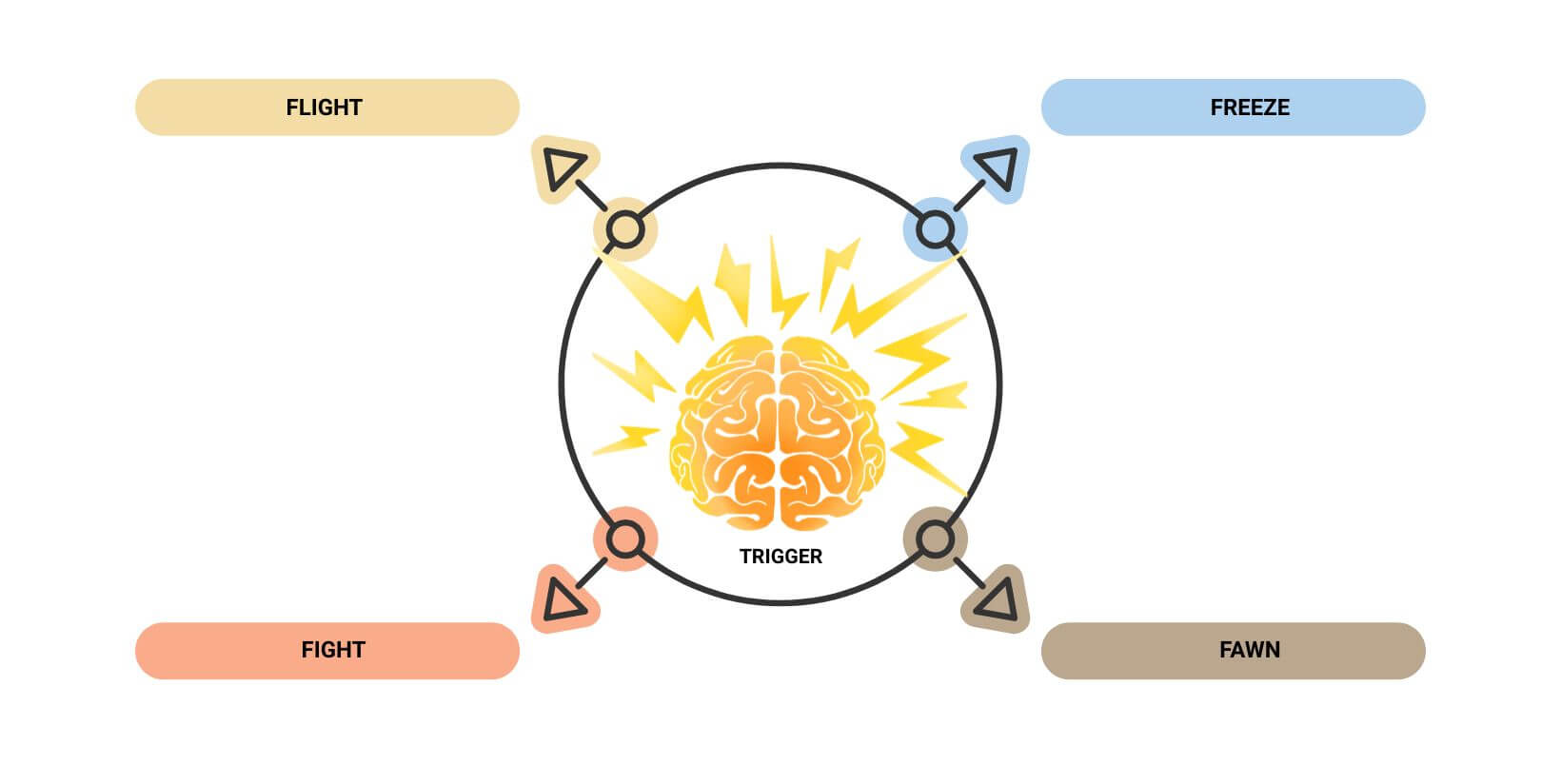
Freeze is what happens when your brain believes you can't fight or flee. Instead, you go still. Like a bunny rabbit who freezes in place to avoid being seen, you go quiet. Of course, you aren't a bunny rabbit, so you may smile and nod, going about your routine while everything inside you shuts down. Later, you might not even remember parts of the conversation. This is your brain's last-ditch effort to keep you safe: if I can't fight and I can't run, I'll just . . . vanish.
Fawn is a kind of freeze response. It's different in that it adds the motive of appeasing, or trying to make the attacker happy, rather than simply going quiet. You might be familiar with the phrase, "people-pleasing." It's that.
There's overlap between freezing and fawning, but in fawning, there is almost always a form of "maybe if I do this for them, they will not be mad at me" motive involved. Our bunny rabbit would never add the appeasing motive into its reaction; trying to make friends with the hunter would obviously not end well for the rabbit.
Here's what's important to understand: none of these responses are character flaws. They're survival strategies. And at some point in your life, they worked.
While you're asking yourself, "Why do I do this?" I think a helpful add-on question is, "What was happening in my life when my brain decided this was necessary?"
Trauma Memories Can Feel Like Déjà Vu
And while we're being curious about "what was happening in my life . . .," let's explore those strange occurrences where you feel like you got dropped into an awful moment from 20 years ago.
It feels crazy, doesn't it? A sound or smell from "that" season can introduce a complete immersive experience in your body that you know isn't real, even while you're feeling all the feels. I remember being blindsided by such an experience many years ago . . .
My parents frequented bowling alleys constantly during the season of my childhood when I was sexually abused. I'm sure I had gone bowling in my early teens, so I wasn't avoiding bowling alleys in later years, but bowling wasn't a cherished hobby. It had been decades since I'd been in that environment. One afternoon, I joined some friends to go bowling. My only concern at the time was whether I would make a fool out of myself after 25 years.

It hit me the moment we walked inside. I was completely unprepared, and entirely overwhelmed, by the sights and sounds that immediately took me back to a traumatic season of my young life. In a flash, I was once again five years old, but wearing a 30-something-year-old body.
What was THAT??? It felt like déjà vu. But it was actually a known and common trauma response. My brain had taken a quick look through its archive of my memories and interpretations of them, found the bowling alley collection, and decided "this" felt like "that," and therefore I was unsafe. So it "triggered" me to get me out of there.
Trauma Memories Are Stored Differently In Your Brain
This is important: trauma memories aren't stored the same way regular memories are. They're fragmented - stored as sensations, emotions, images, body responses. So when something in your present triggers one of those fragments, your brain recalls the feeling of that larger situation that happened 20 years ago. It does not usually provide the entire narrative or storyline with all its context. It's more of "sense," brought to the forefront of your mind as an image, feeling, sound, or scent that is just as real-seeming as it was when it happened.
Suddenly, you're anxious, or you feel like crying, and you can't explain it (even to yourself). Or you're angry, way out of proportion to what just happened. Or maybe you feel small and powerless, even though objectively, you're not. As I said in my story, I was no longer a five-year-old child in that bowling alley. But I felt like one.
This is why people say things like "I know it doesn't make sense, but..." Because logically, you can see that your current situation is different. But your body and your emotions are responding to an old threat, not the present moment.
How Trauma Affects Relationships
Speaking of responding to an old threat, "people" are often the most significant old threat we have to deal with. Even if the person can no longer hurt us, the memory of our experiences with them casts long shadows into our todays. Why does this matter?
Well, when we talk about trauma, abuses that occur between people are more harmful to us than the crises caused by impersonal events. I mean, a toxic marriage or an abusive parent dispenses more hurt and harm than a tornado that flattens your house. This is because the tornado is not a person. And that makes a difference.
If we compare different kinds of interpersonal hurts and harms, the closer and more intimate your relationship to the person who has hurt you, the deeper and more significant the hurt.
The tornado isn't human. The random burglar doesn't know you. But your spouse or parent is intimately connected to you. An emotional injury from each of these, taken in order, is going to be more and more deeply felt based on your relational connection.

Why Relationships Matter in Trauma Recovery
What makes this such a big deal is that God created you for relationship - with Him and with other people. That's not just a nice idea; it's how you're wired. Your brain is designed to connect, to trust, to be known, and to know others.
As a result, because His intent for relationships is at the very heart of our human experience, trauma attacks it, and us, at our very core. This is why it can be so devastating when our relationships dissolve, even ones that we struggle with. I wrote an article about relationships and shame; check it out here.
Yet as much as we need relationships and connection, our brain has another priority: to keep us alive. The same brain that's built for connection is also built for survival. And when connection and survival come into conflict - when the people who were supposed to love you became the source of danger - your brain makes a choice for you.
It chooses survival. Every time.
Isolating Feels Safe (But it's a Trauma Response)
To keep you safe from toxic relationships, your brain tries to keep you safe from all relationships. It does this by leaning into isolation. This means you learn to keep people at arm's length. To be friendly but never really vulnerable. To present a version of yourself that appears to join in, but keeps the real you hidden.
This worked when you needed it to. But it's not how God intended you to live. And it may not be working anymore.
A frustrating truth about trauma and recovery is: the very thing that kept you safe "back then," is the very thing that's keeping you stuck "right now."
The mental dissonance feels crazy. Your brain learned to protect itself through isolation, but healing happens in connection. With God, yes, but also with safe people. Friends. Therapists. Competent mentors. In short, with trustworthy people who can help you experience life without sending your nervous system into high alert.
I know from experience how impossible it sounds when you can't even imagine trusting anyone, ever again. But as I began to understand trauma better, it made more sense. And I learned that getting the outside perspective from someone who has been there can help. A good therapist or mentor can help you see what you can't see yet. They can help you keep your balance as you take those baby steps toward healing.
God made us for each other. Pursue that.

Hope For Healing: Your Brain Can Change
Okay, I get it. I see you. You've read a lot of words, you have tucked a few bits of information in your back pocket, and . . . you still feel stuck. I'll go so far as to say maybe you are stuck.
But the big news here is that you don't have to stay stuck.
Look: your brain is not a big ol' rock where your toxic memories are etched forever in cellular cement. Neuroplasticity, a kind of cellular flexibility, allows your brain to change from birth to death. It's the antidote to "stuck." Neuroplasticity is the mechanism your brain uses to form new patterns, new pathways, and new responses. The Mayo Clinic has an interesting article on it here.
This means that the alarm system that got stuck in the "on" position can learn to recalibrate and reduce your hypervigilance. The automatic responses that don't serve you anymore? They can be retrained. The old thinking habits that keep you small and afraid? They can be replaced with truth and new habits that help you embrace your space in the world and breathe freely again.
This healing doesn't happen overnight. And it doesn't happen by willpower alone. But it does happen.
It begins as you learn why your brain does what it does. It takes a few steps forward when you stop fighting against your own nervous system and learn how to work with it, instead. And your small successes continue as your brain falls in step with your logical recognition of the difference between a real threat and an old echo.
It happens when you bring God's truth into the places where lies have been running the show.
What Trauma Recovery Actually Looks Like
Understanding trauma isn't about diagnosing yourself or labeling everything that's hard. It's about clarity. It's about finally having language for why you feel the way you feel, why you do what you do, and why change has felt so impossible.
Once you have more clarity, you can start to make different choices. Small ones at first, like noticing when your body is responding to an old threat instead of a present one. Or asking yourself, "What is my brain trying to protect me from right now?" With help, you can learn to override the automatic response with a conscious one.
This is the work. And it's worth it. You're worth it.
Friend, on the other side of understanding trauma, you'll find freedom. I don't mean you'll never be afraid or triggered or overwhelmed again. I mean that understanding trauma opens the door to recognizing what's happening and choosing a different response. You'll be free to stay present instead of disappearing. Free to connect instead of isolating.
Best of all, you'll be free to live the life God created you for, instead of the one trauma handed you.
“I praise You
because I am fearfully and wonderfully made;
Your works are wonderful, I know that full well.”
Psalm 139:14 NIV
FAQs
That’s wonderful! This space is here to build on that. Even after counseling or recovery work, old thought patterns can resurface in new situations. This site helps you understand what’s happening in your brain and respond with clarity, grace, and God's wisdom.
No. I'm not a therapist, and what I offer on my website is not therapy. It is educational and (hopefully) encouraging. It isn't meant to replace professional mental health care. What you’ll find here are reflection tools, mindset shifts, and biblically grounded encouragement — especially for those who’ve already done some inner work and want to keep moving forward.
Yes. My goal is to educate and encourage. Trauma doesn’t have to be dramatic to be real. If your thoughts feel louder than your faith, or you struggle with patterns like overthinking, avoidance, guilt, or people-pleasing… you’re in the right place.
I don't think so. Everything here is designed to be gentle, thoughtful, and redemptive. I focus more on how to shift patterns than on rehashing the past. If anything does stir up discomfort, please take a break and come back when you're ready.
God created your brain with built-in systems to help you survive. To the brain, survival begins with being safe. But it can over-correct. If you’ve felt stuck in fear, overreaction, or an emotional shutdown — that was your brain trying to protect you. It can feel very "wrong," though, and I have found that understanding some of the brain science of trauma can help normalize some of our reactions. Understanding trauma can offer freedom and peace.
Yes, for the most part. You’re welcome to share links, quotes, or small parts of blog articles as long as you credit the source. Limitations would be that the printed resources are intended to be purchased by each individual, and the free ones are given as a gift in exchange for your email address, so I can let you know about upcoming events or resources. If you'd like a resource created for a specific need, feel free to let me know what topics and ideas would serve you best. I love to hear from my peeps!
Absolutely. This space is designed to help you understand how your thoughts and habits have been shaped by both your story and your God-designed brain — and how biblical truth and some practical resources can begin to shift those patterns.
You won’t find pressure here, just quiet tools, gentle encouragement, and a deeper understanding of why you think and feel the way you do — so you can move forward with more clarity and peace.
You can start right here. There's a navigation bar at the top of this page. Check out the "blog" section there for more articles. If you click on the Home tag, you'll drop into my homepage, where you can begin to explore anything that grabs your attention. You don’t need a perfect plan, either. Just explore the sections that speak to you most, reflect on what connects, and let the Holy Spirit guide your next step. And don't hesitate to contact me with comments or questions. I'm more than happy to help.
Under Development (Coming Soon!)
Journaling thru Proverbs: 31 Days...
Ready to grow in wisdom and make decisions you won't regret? A daily dose of Proverbs and its timeless wisdom might be just what you need. This journal guides you to reflect on key decisions, past experiences, and future choices. Each day, you'll discover fresh insights for your journey.
Dream it, Do it: Choosing Courage...
Those negative voices you thought were gone? They're back, trying to keep you from stepping into what God has for you. In four weeks, you'll learn to recognize the lies, hear God's voice more clearly, and choose the courage of trusting Him over the false certainty of staying small.
Exit Plan: Ditch the Drama...
Ditch the drama of toxic social situations with a personalized, recovery-friendly exit strategy that works. You want to be optimistic, but you can be blindsided by the drama. You've worked too hard to let your God-given desire for relationship lead you in the wrong direction.
This journey is personal. Understanding trauma helped me heal.

Like you (I presume), I once thought I was the only one.
I didn’t understand why I felt constantly on edge, why I flinched at loud noises, or why I couldn’t just “get over it.”
I wondered why, when I wanted to do something new or that would put me in the spotlight, I would begin thinking of all the reasons I shouldn't do it. Even when I knew I should.
I didn’t know my brain was doing exactly what God had designed it to do — keep me "safe." The problem was that it was pulling its instructions out of the archives, and those old, outdated patterns weren't helpful.
Learning the science behind trauma helped me breathe again. It gave me freedom as I saw my crazy thoughts and actions as survival responses rather than character defects.
Now, I get to help others learn what I’ve learned, starting with this: you're not the only one. You’re not broken, you’re beautifully designed. And you’re not stuck forever. There is a way forward, and I can help you discover it.
100%
God's gotcha
guarantee
I'm So Glad You Stopped By
I hope this page reminds you that your brain is just doin' its thing. It's trying to keep you safe — even if it's a little misguided at the moment. We're asking it to do something different now. And that's okay.
It's all part of the process. God's got you. He's not angry with you or disappointed. He's not surprised. And He's definitely not finished with you yet. (In a good way).
And speaking of not being finished, if you'd like just a bit more encouragement, I have a short devotional ready for you. (Yeah, you need to drop your email address to get it, but if you've read this far? It's probably perfect for you.)
Fill out the little form below and I'll send it your way.